
Next week officially begins the new academic year for me. It’s later than most as my University is on the quarter system. I have been enjoying my last full week of “summer” working on dueling writing projects. For two days in a row, I started with a modest writing goal for one project and then make amazing progress on the opposite one. It seems like procrastination is my superpower. Perhaps as I am supposed to be preparing my class materials over the next two weeks, my procrastination energy will finish them both!
Now rather than working on either project, I’m sitting here writing a blog post. Go figure.
The beginning of the year is stuffed with “retreats.” There is one for the the School of Interdisciplinary Arts and Sciences, one for the Division of Science and Math, and one for the Mathematicians all by themselves. I’ve been thinking about (dreading?) upcoming meetings a lot. I do enjoy my colleagues for the most part so there is a bright side.
Yesterday I got a LinkedIn message from a former staff member at MAA . She shared news about her new leadership position and sought tips and advice for running a good Council meeting because “I really loved the way you lead our Board Meetings. ” I spent some time responding to her request and decided to share it here, too.
Jenny Q’s Tips for Running a Meeting
Step 1. Set the goal(s) of your meeting. What do you want/need to get accomplished? Are you:
- prioritizing work for the year?
- onboarding new members? (or reminding returning members of their roles and responsibilities?)
- digging into a specific problem?
- working towards systemic change?
You should be able to state your goal(s) is a short sentence or two and have an actionable outcome and timeline you are striving towards.
Step 2. Create the agenda and organize the meeting so you can reach that goal.
I like to make the meeting active (just like I want to have my classroom active). I use Liberating Structures (https://www.liberatingstructures.com/) as a resource. I know many people are uncomfortable with what they consider “touchy-feely” activities, but they really do keep people engaged and include more voices. Simply calling on volunteers in a discussion is the default mechanism in a classroom or a boardroom—and it is rarely equitable or inclusive.
Enlist the help of others. Not only in creating the agenda, but also designing and facilitating the activities (there is more buy in that way). If possible, I like to have an opening ice breaker/small group activity that aligns with the goal(s). I try to let people know what the activity will be in advance if possible.
At my last MAA Board meeting as president (November 2022), our ice breaker was a Liberating Structure Mad Tea Party, which aligned with our need to begin preparing a new strategic plan. It allowed us to greet one another personally and briefly discuss leading prompts (16 of them, a different one for each person you met).
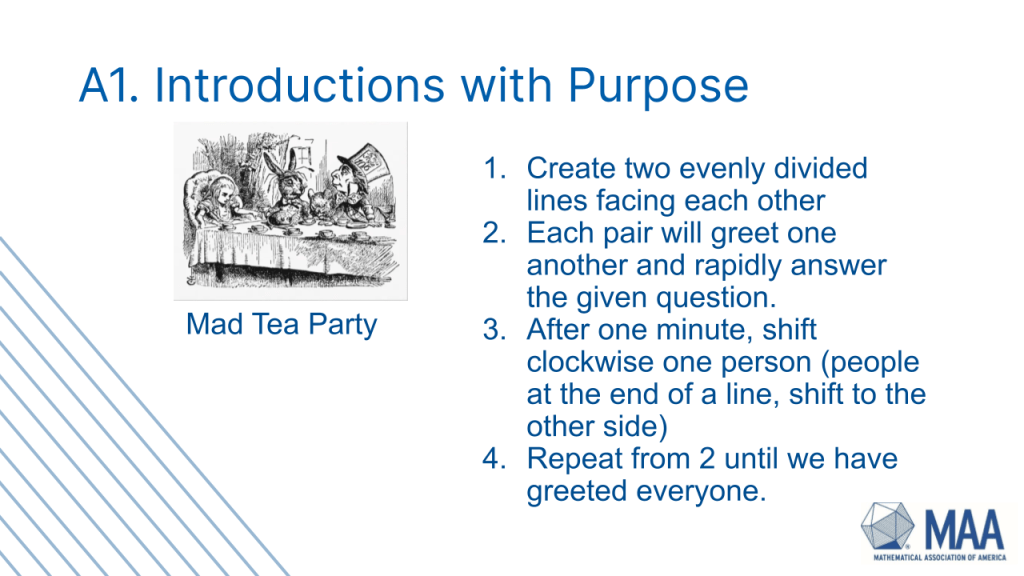
I learned a few things about implementation including some clever PowerPoint hacks to visually display time, indicate who’s turn it was to speak, and automate the display of new prompts. The activity was loud and boisterous. It engaged everyone and seeded ideas for later topics. Was it risky? A little bit (especially because I had never done something like this before)—but definitely worth it. A thirty minute ice breaker may seem long but it was appropriate for a 2 day meeting.
Step 3. Share the agenda and any prework at least a week in advance.
This is an ideal. I do not always achieve it myself but I try.
Step 4. Anticipate controversial items and prepare strategies to respond.
This is another place to enlist the help of others. We all see different things. I have been blindsided by unanticipated controversies. I have been shocked when items I thought would be difficult sailed right through. And I have been grateful for the planned support when expected controversies materialize as anticipated.
Step 5. Make it happen.
Stick to your agenda but be willing to improvise as needed.
Respect people’s time. If the information could just as easily be conveyed through an email, then use email.
To the best of your ability, use the people in the room to make progress towards your goals. This means creating a safe space for collaboration (usually setting some ground rules, clarifying confidentiality expectations, and agreeing to inclusive practices.)
Always remember someone in the room is new to the organization. So any problem (both old and new) requires a brief background. And please don’t use acronyms without explanation. This can be particularly isolating.
End on a positive note and on time. I like to end with some kind of written reflection—either recording lessons learned, committing to an action item, or some kind of affirmation. These are often anonymous (sticky notes IRL or online like Padlet) but capture the accomplishments from the meeting in a genuine way that can be more meaningful than the minutes.
I revisit the reflections in advance of the next meeting as a form of self-assessment. It gives a good start on creating the next agenda and can provide milestones to check progress towards meeting our goals.
 Math Belongs to All of Us